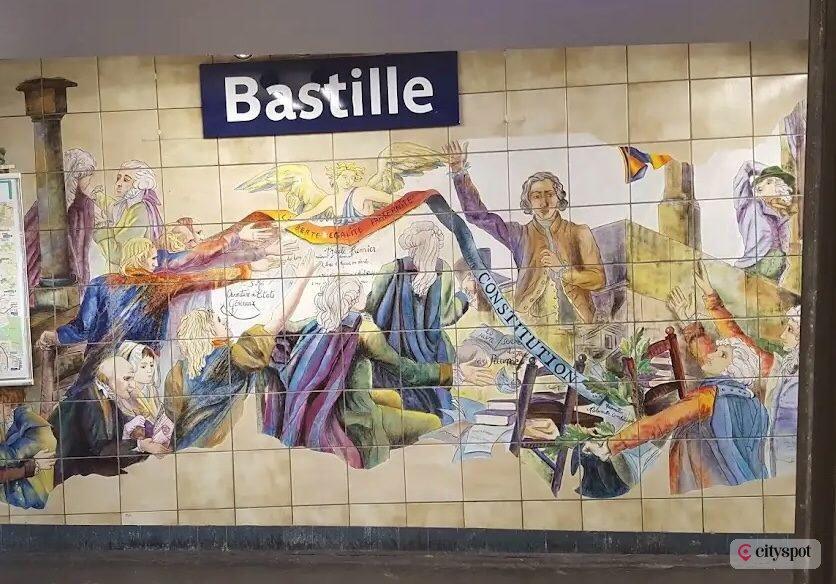
Mural in Bastille Metro station — Photo: property of CitySpot
Right Bank · 11th & 12th arrondissements
Bastille & Faubourg Saint-Antoine: A Fortress Gone, a Furniture Craft Still Alive
The Bastille fortress-prison, stormed on 14 July 1789 in the event that ignited the French Revolution, was demolished within months, and nothing of it remains. The neighboring Faubourg Saint-Antoine, meanwhile, had been the furniture-making district of Paris since the Middle Ages, exempted from the usual craft-guild restrictions so that cabinetmakers could set up shop and innovate freely.
Start at the July Column, which commemorates the revolutions of 1830 and 1848 (not, despite appearances, the 1789 storming it is often mistaken for). Then browse the furniture workshops of the Faubourg Saint-Antoine and catch a concert at the Opéra Bastille, built for the Revolution's 1989 bicentennial. The neighborhood's working-class, rebellious streak never fully went away: it is still where Parisians march when they want to be heard.
Rue du Faubourg Saint-Antoine, a street of furniture makers for centuries, runs east from Place de la Bastille, and some of its hidden courtyards, like the Cour de l'Étoile d'Or at no. 75, still house workshops. Close by, rue de Lappe and rue de Charonne are the neighborhood's nightlife streets, rue de Lyon leads to the Opéra Bastille at no. 120, and the Marché d'Aligre on Place d'Aligre is one of the city's most popular markets.
Only seven prisoners were actually found inside the Bastille when it fell: two "lunatics," four forgers, and an aristocrat jailed at his own family's request. That was far fewer than revolutionary legend later suggested, and a letdown for the crowds who had expected to liberate dozens of political captives. The Faubourg's cabinetmakers, meanwhile, once supplied furniture to Versailles itself, a trade still visible today in the workshops tucked behind unmarked doors.
More from the history books
The Bastille began as a medieval fortress, built between 1370 and 1383 under Charles V to guard the Porte Saint-Antoine, the city's eastern gate. It became a state prison only in the 17th century, under Cardinal Richelieu. Its inmates included Voltaire, imprisoned there in 1717 and again in 1726, and the still-unidentified prisoner known as the Man in the Iron Mask, who died in the Bastille in 1703.
After 1789 the fortress was demolished with remarkable speed. Its stones were reused, some reportedly in the Pont de la Concorde, while an entrepreneur, Pierre-François Palloy, made a business of selling souvenirs carved from them. A later oddity of the square was a plaster elephant, commissioned by Napoleon in 1813 as a model for a monumental fountain: it stood on the site for decades, slowly decaying, and Victor Hugo gave it a cameo in Les Misérables as the home of the street urchin Gavroche.
3 key numbers
Only 7 prisoners were actually inside the Bastille when it fell on 14 July 1789
1830 and 1848 — the two later revolutions actually commemorated by the July Column, not the famous 1789 storming
600+ years the Faubourg Saint-Antoine has specialized in fine furniture-making, since medieval times
We recommend…
- 📍 Place de la Bastille — Place de la Bastille · Metro: Bastille
- 📍 Opéra Bastille — 120 rue de Lyon · Metro: Bastille
- 📍 Marché d'Aligre — Place d'Aligre · Metro: Ledru-Rollin
- 📍 Cour de l'Étoile d'Or — 75 rue du Faubourg Saint-Antoine · Metro: Ledru-Rollin
Did you know?
- You can still trace the Bastille's exact footprint: a line of paving stones runs across Place de la Bastille marking where its towers once stood.
- Rue du Faubourg Saint-Antoine's inner courtyards ("passages") once hid entire workshops from street view, letting cabinetmakers avoid city guild taxes.
- The July Column stands on the site of the old Bastille moat and contains the remains of victims from the 1830 and 1848 uprisings inside its base.

Explore Bastille & Faubourg Saint-Antoine with CitySpot
Download the CitySpot app and turn your phone into an audio guide to discover 500 points of interest in Paris, as well as many themed walking tours across the city.